 Pompeii Tours from Naples
Pompeii or Herculaneum? An Honest Comparison
Last reviewed August 2026
Pompeii or Herculaneum, if you only have one day and have never seen either? Pompeii. If you have seen a Roman city before, or you are travelling with anyone who wilts in the heat, Herculaneum is the better afternoon. The two towns were destroyed by the same eruption in different ways, which is why one gives you scale and the other gives you wooden roof beams that are still in place. Both sit on the same railway line out of Naples. Here is the comparison in full, with 2026 ticket prices and what a day trying to do both actually looks like.
Quick answer Which one to pick, how they differ, and whether both fit in a day
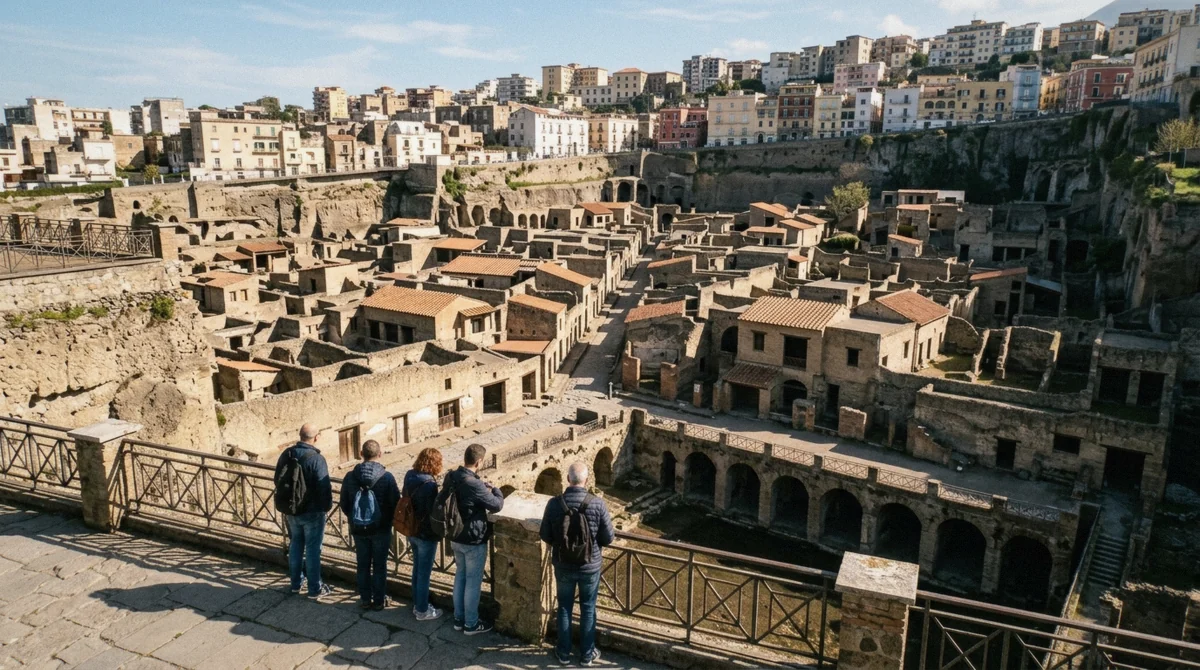
Pompeii for a first visit and for scale: 66 hectares, a full street plan, the Forum, the amphitheatre and the casts. Herculaneum for preservation and quiet: a tenth the size, two hours to see properly, with upper storeys, carbonised roof beams and furniture that Pompeii lost. Both are on the Circumvesuviana from Naples, and three tours pair them in one day with about two guided hours at each.
Key takeaways
- Herculaneum is closer to Naples and takes about two hours; Pompeii cannot be seen in one visit
- Entry is €16 at Herculaneum against €20 or €25 at Pompeii, depending on the grade
- Pompeii caps entry at 20,000 a day; Herculaneum has no comparable cap, which is why it feels empty
- Doing both in one day works, and the tours that do it give you two guided hours at each
- Same line from Naples: Ercolano Scavi for one, Villa dei Misteri for the other
Pompeii or Herculaneum at a Glance
Six things separate them, and only one of them is famous. Figures checked against the parks' own information and the operators' listings in August 2026.
| Pompeii | Herculaneum | |
|---|---|---|
| Size | 66 hectares, more than 1,500 buildings | Roughly a tenth of that |
| Time needed | Two hours for the guided route; three or four to reach the amphitheatre | About two hours to see it properly |
| Adult ticket | €20 express or €25 with the villas | €16 |
| What survived | The street plan, the Forum, the casts, the scale of a lost city | Upper floors, roof beams, doors, a wooden screen, furniture |
| Crowds | Capped at 20,000 a day and it feels like it | No comparable cap and far fewer visitors |
| From Naples | Villa dei Misteri, 35 to 40 minutes | Ercolano Scavi, about 20 minutes, then a downhill walk |
The row that decides most visits is the second one. Pompeii is not a site you finish, and accepting that before you arrive changes the day for the better. Herculaneum is a site you can finish, and finishing something is a real pleasure at the end of a week of ruins.
Why They Look So Different
Same volcano, same day, two different ways of dying.
Pompeii lay downwind and was buried under metres of falling pumice and ash over many hours. The weight collapsed roofs and upper floors, and anything wooden that was not crushed later rotted in the wet ash. What the ash preserved instead was the shape of the city and, famously, the voids left by bodies, which nineteenth-century excavators filled with plaster to make the casts.
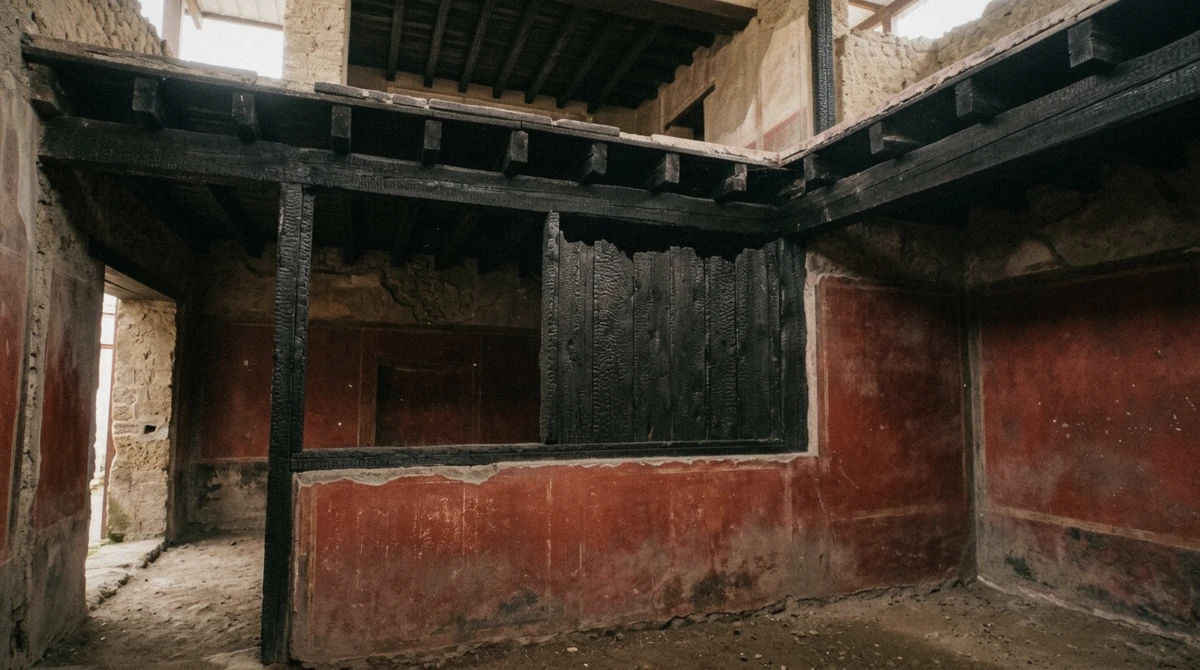
Herculaneum was hit by pyroclastic surges: clouds of superheated gas and debris moving fast enough to arrive in minutes rather than hours. The heat carbonised organic material rather than burning it away, and the surge sealed the town under a dense deposit that set hard. So the wood is still there, black and cracked but standing: beams across ceilings, door frames in doorways, a screen, a bed.
That single difference explains nearly everything a visitor notices. Herculaneum has second storeys you can look up into. Pompeii has horizons.
What Herculaneum Has That Pompeii Does Not
Wood, and rooms with lids on
Carbonised beams still spanning rooms, a wooden partition screen, door frames, shelving, and in places a whole upper floor. In Pompeii you look at foundations and imagine a house; in Herculaneum you stand inside one.
Better mosaics and better colour
The surge deposit sealed surfaces from weather and from later looting, so the reds and blacks on the walls are stronger and the floor mosaics sharper. Herculaneum was also a wealthier seaside town than commercial Pompeii, and it shows in the decoration.
Quiet, and a shape you can hold
There is no daily cap because there is no crowd to cap. The whole excavation is visible at once from the terrace above it, which orientates you in a way Pompeii never does. Two hours and you have seen it, rather than two hours and a sense of having missed most of it.
The boat chambers
The arched chambers along the ancient shoreline, where several hundred people sheltering from the eruption were found in the 1980s. It is the most affecting thing at either site and almost nobody on a coach tour reaches it.
What Pompeii Has That Herculaneum Does Not
The scale of an entire city
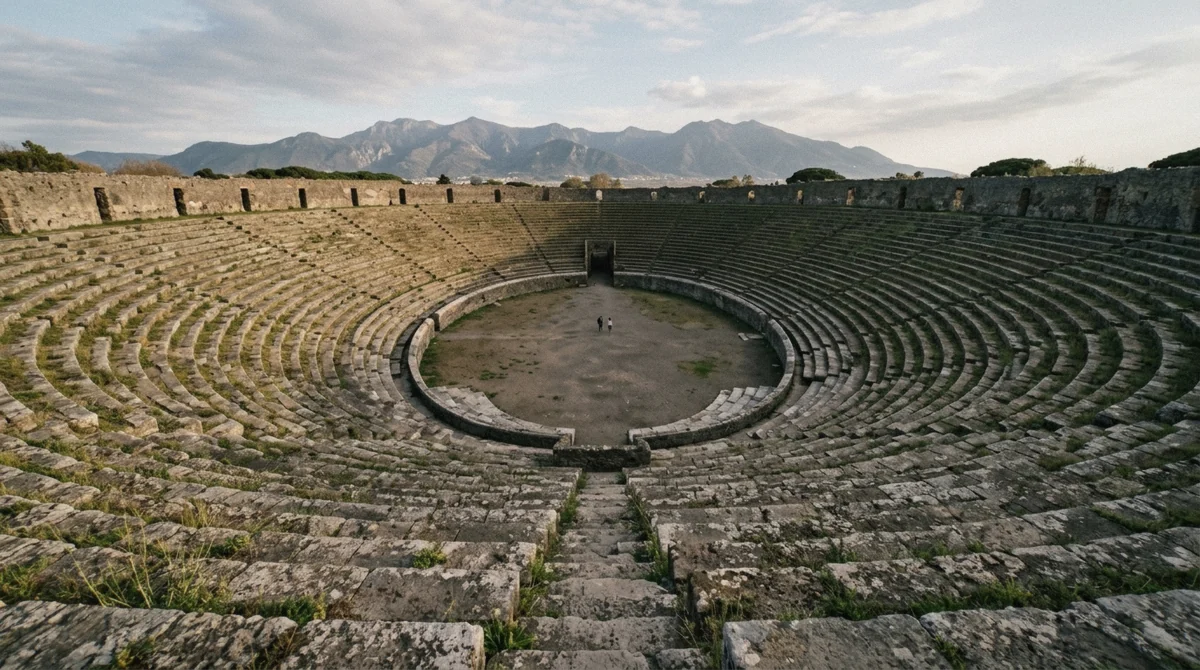
Sixty-six hectares, a full street grid with kerbs and crossings, an amphitheatre that held twenty thousand people, two theatres, four public bath complexes, thirty-odd bakeries and a brothel. You cannot get that from a town a tenth the size, whatever its ceilings are like.
The casts
The plaster casts of the victims are at Pompeii, in the granary at the edge of the Forum and in a few other locations. They are the reason many people come and there is no equivalent at Herculaneum, where what was found was skeletons rather than voids.
The Villa of the Mysteries
The near-complete fresco cycle outside the walls, and the single most reproduced image of Roman painting. It needs the €25 ticket or an €8 add-on at the Herculaneum Gate, which is the ticket trap worth knowing about before you book anything.
The view of what did it
Stand in the Forum and Vesuvius lines up behind the columns of the Temple of Jupiter. Herculaneum sits closer to the volcano but in a modern town, so you rarely get that sightline.
Which One, for Whom
If It is your first Roman site and you have one day
Pompeii, and accept that you will not see all of it
If You have already walked a Roman city
Herculaneum, where the surprise is the wood and the upper floors
If You are travelling with children
Herculaneum: it is smaller, shadier, and finishable before anyone melts
If It is thirty-plus degrees
Herculaneum in the afternoon; Pompeii has almost no shade anywhere
If You are on a cruise call under seven hours
One site, and make it Pompeii, with the timing worked out here
If You want both and have a full day
A two-site guided day, which solves the transfer between them
Getting to Each One from Naples
They share a railway. The Circumvesuviana from Napoli Porta Nolana or Garibaldi towards Sorrento stops at Ercolano Scavi after about twenty minutes for Herculaneum, and at Pompei Scavi, Villa dei Misteri after 35 to 40 minutes for Pompeii.
At Herculaneum you walk about ten minutes downhill from the station to the entrance, through the modern town and past the point where the ancient shoreline used to be. At Pompeii the gate is a hundred metres from the platform. Fares are the same commuter fares either way, and every one of the guided Pompeii tours from Naples we compare covers the road version of the same trip, and the full transport picture is here.
One consequence worth planning around: Herculaneum is on the way to Pompeii. If you are doing both independently on separate days, doing Herculaneum first costs you almost nothing in travel time.
Can You Do Both in One Day?
Yes, and it is a long day rather than a rushed one, provided you accept two hours at each. That is enough for Herculaneum and it is a compressed version of Pompeii.
Three tours on this site pair them, and they differ more than the fifty-dollar spread suggests.
| Tour | From | What is included | The catch |
|---|---|---|---|
| Minibus with an archaeologist | $150 | Both tickets named, archaeologist all day, group of up to 20 | 50 minutes at a shopping outlet between the two sites |
| Small group with pickup | $138 | Both tickets, archaeologist, hotel pickup, no retail stop | Lunch only on the option that includes it; four people minimum in winter |
| Full day with lunch | $104 | Lunch, audio guide in eight languages, pickup | A host rather than a guide, and tickets only on the ticketed option |
Doing it independently is cheaper and slower: two commuter fares, two tickets at €16 and €20, and the discipline to leave Herculaneum on time. The tours are buying you the transfer between the sites, which is the part that eats an independent day.
The order matters more than people expect. Herculaneum first, while you are fresh and while Pompeii is filling up with the morning coach wave, then Pompeii in the afternoon. Most of the tours above do it that way; the cheapest one does not.
Tickets and Hours for Each
Herculaneum charges €16 for an adult, as printed by the operator of the two-site minibus day. Pompeii charges €20 for the express ticket or €25 for Pompeii+ with the suburban villas, a split introduced on 12 January 2026. Which grade you need, and why it matters.
Pompeii opens at 09:00 and closes at 19:00 from 16 March to 14 October, with last entry at 17:30, and closes at 17:00 in winter with last entry at 15:30. It is closed on 25 December and 1 January. The seasonal timing in full.
The practical difference is the booking. Pompeii tickets are personal and rationed by time slot against a 20,000-a-day cap, so they want planning. Herculaneum does not run a comparable cap, which is the administrative reason behind the emptiness you notice when you walk in.
Pompeii or Herculaneum: Common Questions
Which is better, Pompeii or Herculaneum?
Neither, in the abstract. Pompeii is better for a first visit and for scale; Herculaneum is better preserved, quieter and finishable in two hours. If you have never seen a Roman city, the scale is the thing you came for, so start with Pompeii.
Why isn't Herculaneum as famous as Pompeii?
Size and story. Pompeii is ten times larger, was excavated earlier and more extensively, and produced the plaster casts that made the eruption legible to the public. Herculaneum sits partly under the modern town of Ercolano, which limits how much can ever be uncovered.
Can you do both Pompeii and Herculaneum in one day?
Yes, with about two hours at each, which is right for Herculaneum and compressed for Pompeii. Three guided days on this site do exactly that from Naples, and independently it works too if you take Herculaneum first and hold to a departure time.
How long do you need at Herculaneum?
About two hours to see it properly, including the boat chambers along the ancient shoreline. It is roughly a tenth the size of Pompeii and the whole excavation is visible from the terrace above the entrance, so it is unusually easy to plan.
Is Herculaneum less crowded than Pompeii?
Considerably. Pompeii caps admissions at 20,000 a day and the coach wave from Naples arrives inside the same hour; Herculaneum has no comparable cap because it has no comparable crowd. At the same hour on the same day, the difference is obvious.
Which one should I visit first?
Herculaneum, if you are doing both. It is closer to Naples, it takes half the time, and doing it in the morning leaves Pompeii for the afternoon when the half-day coaches have gone home.
How much are tickets to Herculaneum?
€16 for an adult, as stated on the listing of the operator that runs the two-site day from Naples. Pompeii is €20 or €25 for the same day depending on whether you want the suburban villas.
The two towns are not competing for the same visit. Pompeii is a city you sample; Herculaneum is a town you finish. If the trip allows only one, the size and the casts make Pompeii the first visit for almost everyone, and the wood makes Herculaneum the one people talk about afterwards.
If it allows both, the two-site days from Naples solve the awkward part, which is the hour in the middle.