 Pompeii Tours from Naples
What to See in Pompeii: The Route, in Order
Last reviewed August 2026
What to see in Pompeii in two hours is a single line across the western half of the city: Porta Marina, the Forum, the granary with the casts, the baths, a bakery, the food counters, the Lupanare, and the House of the Faun. That is the route every guided tour walks and it is the right route. What it does not reach is the amphitheatre at the far end and the Villa of the Mysteries outside the walls, and both are worth planning for. Here is the whole walk in order, with the distances between stops, as of August 2026.
Quick answer The route in order, how long it takes, and what two hours misses
Walk west to east from Porta Marina: Temple of Apollo, the Forum with Vesuvius behind it, the granary and its casts, the Forum Baths, a bakery, the thermopolium counters, the Lupanare, the Stabian Baths, the House of the Faun. About two hours at a walking pace. Add an hour to reach the amphitheatre, and either a €25 ticket or a tour that includes it for the Villa of the Mysteries.
Key takeaways
- The site is 66 hectares with more than 1,500 buildings; nobody sees it all in a day
- The guided route is about two hours and stays in the western half
- The amphitheatre is twenty minutes further east and almost always empty
- The Villa of the Mysteries is outside the walls and not in the €20 ticket
- Which houses are open rotates with conservation work, so check before you go
Is Two Hours Enough?
Enough for what, is the honest reply. Two hours is enough to walk the guided line and stop properly at six or seven places. It is not enough to see Pompeii, and no length of visit is.
Here is what each block of time actually reaches.
| Time inside | What you reach | What you miss |
|---|---|---|
| 1 hour | Forum, granary and casts, Forum Baths | Everything east of the Forum |
| 2 hours | The full guided route to the Stabian Baths and the House of the Faun | Amphitheatre, Palestra Grande, the villas |
| 3 to 4 hours | All the above plus the amphitheatre and the Palestra Grande at the eastern end | The suburban villas, unless you hold the €25 ticket |
| A full day | The above plus the Villa of the Mysteries and time to sit down | Still most of the 66 hectares |
Every packaged half day from Naples buys you the two-hour row. If you want the three-to-four-hour row, the practical route is the train plus a tour that meets you at the gate, because you keep your ticket and your slot after the guide leaves. The cost comparison is on the homepage.
What to Prioritise, by Time and Company
If You have two hours and a guide
Follow the route below and do not try to add the amphitheatre
If You have half a day and no guide
Walk east first to the amphitheatre while the coach wave is at the Forum
If You came for the frescoes
The Villa of the Mysteries, which needs the €25 ticket or an €8 add-on
If You are with children
Forum, casts, a bakery and a thermopolium, then stop. Four stops beats twelve
If You have seen Roman cities before
Skip the Lupanare queue and spend the time on the Stabian Baths and the eastern end
If It is over 30 degrees
Two hours in the morning, and treat the amphitheatre as a different day
The Route, Stop by Stop
The walk every guided tour takes, with the honest walking time between stops. Times assume you stop and look rather than march.
-
0 min
Porta Marina and the ramp
The main gate, and a steep cobbled ramp up into the city. The ticket office and the separate group entrance are both here.
-
5 min
Temple of Apollo
The oldest religious building in the city, with its colonnade and the bronze replicas of Apollo and Diana. It opens onto the Forum, so most people walk through it without registering it.
-
10 min
The Forum
The main square, with the brick podium of the Temple of Jupiter at the north end and Vesuvius lined up behind it. Markets for textiles, meat and grain ran off the sides.
-
20 min
The granary and the casts
Alongside the Forum, stacked with amphorae and holding several of the plaster casts behind glass. The most affecting five minutes of the visit for most people.
-
30 min
Terme del Foro
The Forum Baths, with the moulded stucco vault still on the ceiling and the niches where clothes were left.
-
45 min
Via dell'Abbondanza
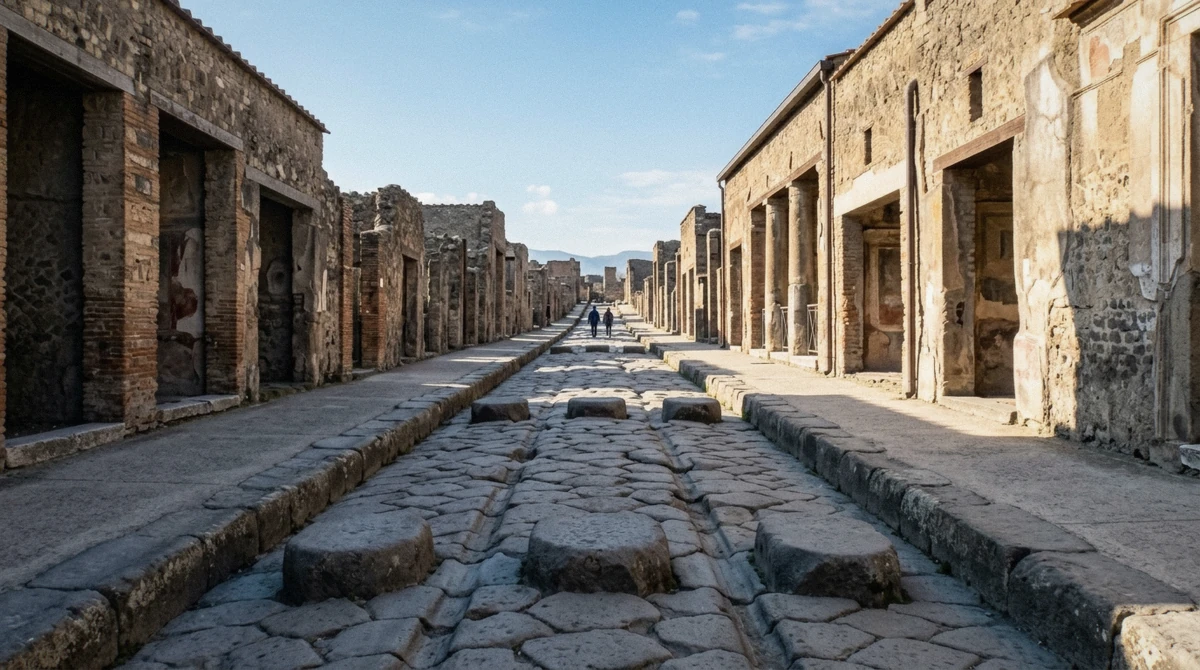
East along the main commercial street: cart ruts worn into the basalt, stepping stones set at axle width, high kerbs, shop fronts.
-
55 min
A bakery, and a thermopolium
Lava millstones and a domed oven in one; a marble counter with terracotta jars sunk into it in the other. Roman fast food and Roman flour, thirty metres apart.
-
70 min
The Lupanare
The brothel, with its erotic frescoes and stone beds, and a permanent queue at the door. Five minutes inside, ten waiting, in high season.
-
85 min
Terme Stabiane
The oldest of the four public bath complexes, where the heating system and the sequence of rooms are still legible.
-
100 min
House of the Faun, and the Tragic Poet
The largest house in the city, whose great mosaics are now in the Naples archaeological museum, and the house with the warning-dog mosaic at its door.
-
120 min
Where the tour ends
Most guided half days stop here and walk back to the coach. If you are independent, this is where the site opens up.
The Forum and What Stands Around It
The Forum is the one part of Pompeii that photographs the way people imagine it: two rows of column stumps, the Temple of Jupiter's podium at the end, and the flat double summit of Vesuvius directly behind. Standing there with the volcano in the frame is the moment most visits turn from sightseeing into something else.
Around it: the Basilica, which was the law court and the business exchange rather than a church; the Temple of Apollo with its colonnade; the macellum, the covered meat and fish market; and the granary, now a store of amphorae and casts behind glass rather than a room you enter.
It is also the least shaded place in Pompeii, which matters more than it sounds in July. Reviewers on the guided half days repeatedly recommend morning departures for exactly this reason, and the seasonal detail is here.
The date on the label is not the date you learned
Almost every book says the eruption happened on 24 August 79 AD. Excavation evidence published in 2018 moved it to 24 October, which fits the autumn fruit, the braziers and the heavier clothing found in the ash better than high summer ever did. Around 20,000 people lived in the area at the time, and a large share of them got out.
Signage across the site is gradually catching up, so you will see both dates during one visit. If a guide gives you August without qualification, that is the older reading rather than an error.
The Streets People Actually Lived On
What to look down at
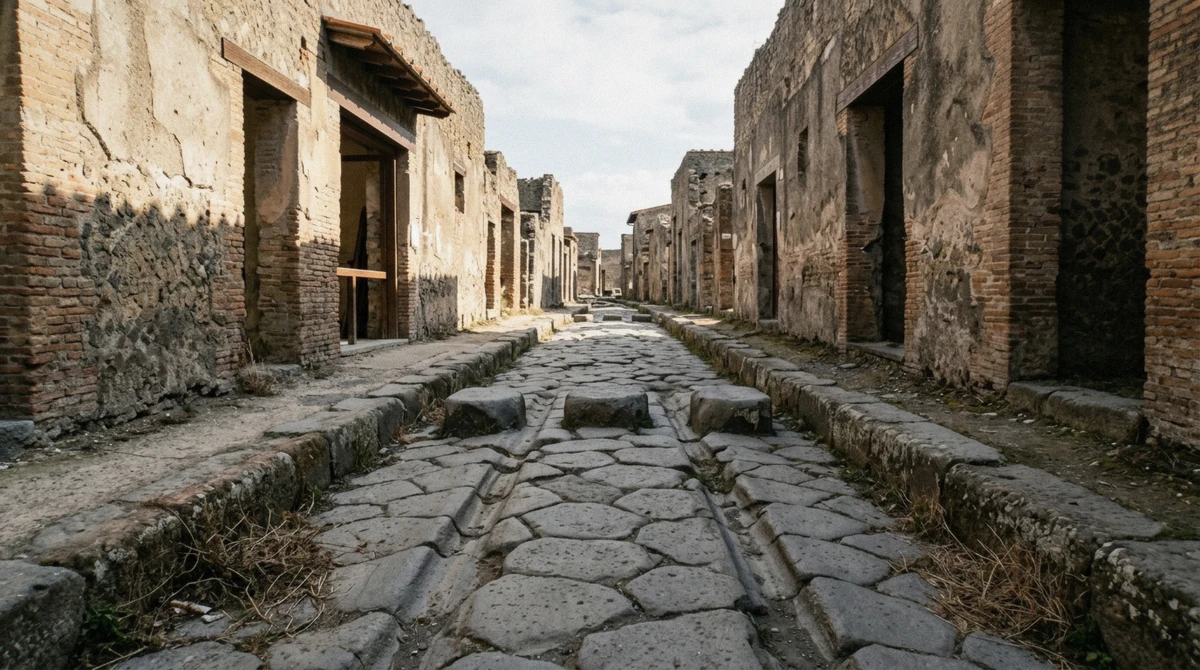
The paving is the exhibit. Deep parallel ruts worn into hard basalt by iron-tyred cart wheels, raised stepping stones set across the road so pedestrians could cross above the run-off, and kerbs high enough to need them. The gaps between the stepping stones are cart-axle width, which is a two-thousand-year-old standards document lying in the street.
Bakeries and food counters
Pompeii had around thirty bakeries. What survives is the hardware: hourglass millstones of grey lava that a donkey or a slave turned, and a domed brick oven that looks like every pizza oven in Naples because it is.
The thermopolia are the other half of the same story: L-shaped masonry counters faced with marble scraps, with wide terracotta jars sunk flush into the top for food. There were dozens across the city, because most Pompeians lived in rooms without kitchens and ate out.
The Lupanare
The purpose-built brothel, ten small rooms with stone beds and painted panels above the doors. It is the most queued-for building in Pompeii and one of the smallest, so budget the wait rather than the visit. Guides handle it briskly and without much ceremony, which is the right call.
The Baths and the Great Houses
Four public bath complexes have been excavated. The Terme Stabiane are the oldest and the most legible: you can follow the sequence from changing room to warm room to hot room, and see the double walls the hot air ran through. The Terme del Foro are smaller and better preserved overhead, with a stucco vault that survives in moulded panels.
For houses, the two names every guide uses are the Casa del Fauno, the largest and grandest in the city, whose floor mosaics including the Alexander mosaic now live in the Naples archaeological museum; and the Casa del Poeta Tragico, small but famous for the mosaic of a chained dog at the threshold.
Further out lie the Teatro Grande, the horseshoe theatre for comedies and mime, and the Templo di Iside, the temple of the Egyptian goddess Isis, which is one of the best-preserved buildings on the site and one of the least visited.
The Two Things No Half Day Reaches
The amphitheatre and the Palestra Grande
At the far eastern end, about twenty minutes' walk beyond where guided tours turn round. The amphitheatre is the oldest surviving stone amphitheatre in the Roman world and held around twenty thousand people, more than the town's own population, so it drew crowds from the whole bay.
Beside it is the Palestra Grande, a colonnaded exercise ground with a pool, where bodies were found at the exit. It is the quietest significant space in Pompeii at almost any hour, for the simple reason that it is far from the coach park.
The Villa of the Mysteries
Fifteen minutes north-west, outside the walls, past the Herculaneum Gate and along the Street of the Tombs. A large suburban villa with a near-complete cycle of red-ground frescoes showing an initiation rite, and the single most reproduced image of Roman painting.
It is not covered by the €20 express ticket. You need Pompeii+ at €25, or an €8 card-only supplement bought on the day at the start of the villas route. The ticket rules in full, and note that the route closes at the same time as the last general admission.
And what else is in the town, besides the ruins
Plenty of people ask what there is in Pompeii apart from the archaeological site, usually because they have a half day left over. The honest answer is that the modern town of Pompei is a working Italian town rather than a destination, but four things nearby are worth the detour, and the first three are free with your park ticket for thirty days.
| Nearby | What it is | Getting there | Cost |
|---|---|---|---|
| Villa Regina, Boscoreale | A working Roman farm with its wine cellar, plus the Antiquarium | Shuttle bus from the site | In Pompeii+, or €8 alone |
| Oplontis, Torre Annunziata | One enormous seaside villa, superbly frescoed and nearly empty | Circumvesuviana, two stops back | €8, or in the 3-day ticket |
| Santuario della Madonna del Rosario | The modern basilica the town grew around, beside Pompei Santuario station | 10 minutes on foot from the eastern gate | Free |
| Museo Archeologico, Naples | Where the mosaics, bronzes and frescoes lifted from these houses actually live | Back in Naples, 40 minutes | Separate ticket |
What Is Open Changes
Pompeii rotates. Houses close for conservation work and reopen months later, and the list of open buildings is genuinely different from one season to the next. The park publishes the current list on its own site, and the most up-to-date version is on the information boards at the entrance.
Two practical consequences. First, do not plan a visit around one specific house without checking. Second, if a guide substitutes a building, that is not a shortcut being taken: it is the site being maintained. The listings themselves say so, with one noting that itineraries vary with overcrowding and temporary closures.
Which Tour Walks Which Version of This
Every guided half day from Naples covers the route above in about two hours. The differences are where you start, whether the guide is guaranteed, and what happens when the guiding stops.
The $70 van tour gives 2 hours 10 minutes inside, the longest of the packaged half days. The $62 tour from the station door names the Forum, the Lupanare and the Thermopolium in its own itinerary. The $38 tour that meets you at the gate runs 90 minutes to three hours and lets you stay on afterwards, which is the only way on this page to reach the amphitheatre with a guide's context behind you.
What to See in Pompeii: Common Questions
What should you not miss in Pompeii?
The Forum with Vesuvius behind it, the plaster casts in the granary, a thermopolium counter, the cart ruts and stepping stones on Via dell'Abbondanza, and the Stabian Baths. If you have longer, add the amphitheatre at the eastern end and, on the right ticket, the Villa of the Mysteries.
Is 2 hours enough to see Pompeii?
Enough for the standard guided route from Porta Marina to the House of the Faun, which is what every half day from Naples delivers. Not enough for the amphitheatre, twenty minutes further east, or the suburban villas outside the walls. Three to four hours covers both.
In what order should I see Pompeii?
West to east, starting at Porta Marina. The Forum comes early, the commercial streets in the middle, the baths and great houses after, and the amphitheatre last if you are going that far. Doing it the other way means walking into the sun in the afternoon.
How far apart are the highlights in Pompeii?
The core is compact: Forum to Stabian Baths is about fifteen minutes at a walking pace. The outliers are what stretch the day, with the amphitheatre twenty minutes east of the guided route and the Villa of the Mysteries fifteen minutes north-west, outside the walls.
Can you see Pompeii without a guide?
Physically yes, and plenty of people do. The difficulty is that the site carries almost no interpretation beyond name boards, so the cart ruts, the counter jars and the bakery mills read as anonymous stonework. Whether a guide is worth it goes through the trade-off.
Are all the houses in Pompeii open?
No, and which ones are open changes with conservation work. The park publishes the current list, and the information boards at the entrance carry the most up-to-date version. Plan the route rather than one specific house.
Where are the bodies in Pompeii?
The plaster casts are displayed in several places, most accessibly in the granary at the edge of the Forum, where they sit behind glass among stacked amphorae. They are casts of the voids left in the ash, not remains, which is why they carry so much detail.
Walk it west to east and stop caring about completeness. Two hours takes you along one street of a city that had hundreds, and the parts that stay with people afterwards are almost never the famous buildings: they are the ruts, the counters and the casts. If you want the eastern end as well, buy yourself the afternoon rather than a longer coach. The Pompeii tours from Naples we compare all walk this same line, and the differences between them are on their own pages.